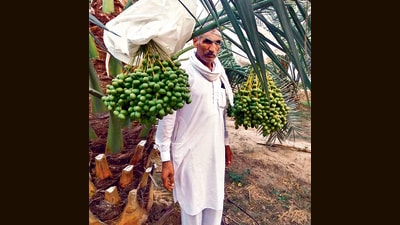

A group of progressive farmers from Abohar in Fazilka district are elated over their maiden harvest of dates, raising hopes for the potential of cultivating the “desert fruit” in Punjab’s semi-arid region.
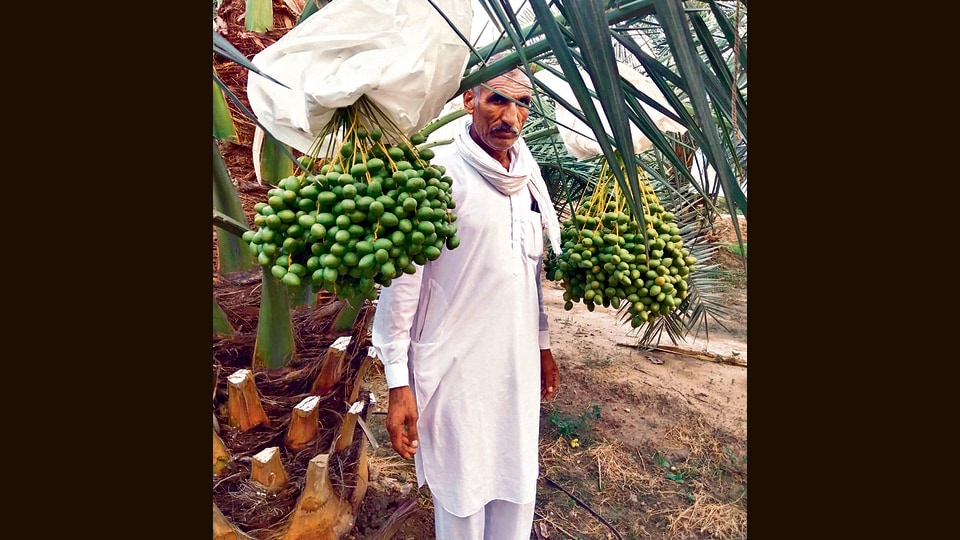
Experts and orchardists in the state’s horticulture hub are seeking direct state intervention, including subsidies and training, under the crop diversification plan.
Date palm saplings produced from tissue culture cost around ₹5,000 each, and around 70 saplings are sown per acre.
Farmers said that the high cost of tissue culture saplings of tested date-palm varieties has emerged as the main roadblock to adopting the hardy crop.
Experts at the Punjab Agricultural University (PAU) said that the climate and sandy soils in various districts of southwest Punjab are suitable for different date palm varieties.
Vimal Kumar Bishnoi, who purchased 155 tissue-culture plants of barhi (yellow colour dates) variety for his orchard at Sukhchain in 2022, harvested nearly 50 quintals of dates in July.
Bishnoi said that over the last several decades, the Abohar belt emerged as the hub of kinnow cultivation, but rising groundwater salinity and unfavourable climatic conditions have damaged a huge area under citrus fruit.
Date palm is less labour-intensive, faces few pest attacks, and trees have a long life.
“Traders purchased a part of my produce at ₹100 per kg, while a portion sold in the local market brought me ₹60 per kg. After facing a substantial loss in kinnow, I decided to switch to date palm farming gradually and found it remunerative. But farmers need awareness and support through subsidies and technical know-how for this emerging horticulture crop,” he said.
Encouraged by the PAU’s fruit research centre in Abohar, another orchardist, Ved Prakash from Diwan Khera, invested in date palm offshoots for ₹2,000 per sapling four years ago.
He bought Barhi and Khuneji (red date) varieties from Gujarat.
The yield of Khuneji is nearly 30% less than Barhi, but its bright red colour fetches a higher price in the market.
Ved rues that saplings produced from tissue culture, recommended by the PAU for better outcomes, were beyond his financial means.
“The state government should extend a subsidy on tissue culture, as offered by the adjoining state of Rajasthan where date palm cultivation is promoted in an organised manner,” he said.
“I harvested dates for the first time this season, and the results were good. Barhi dates were sold at ₹60 per kg, whereas I got ₹80 per kg for the Khuneji variety. An organised push may provide date cultivators markets across the country, as well as export opportunities to Bangladesh and other countries,” he said.
Harpreet Singh Brar, a progressive farmer who was the first to experiment with growing date palms through tissue culture on his land at Khippanwali in 2011, said that the fruit crop has the potential to change the economic condition of the semi-arid districts of Malwa.
“I have scaled up date palm farming from 20 saplings to 7.5 acres, and this season I harvested nearly 350 quintals of Barhi dates. A farmer can harvest an average of 1.5 quintals from a single tree in a season after 5-7 years of planting,” he said.
Brar said that since the kinnow and cotton crops have been hit for the past five consecutive years, several farmers are switching to paddy cultivation even in the semi-arid region.
“The state authorities should devise a policy to conserve groundwater by supporting date palm cultivation at the micro level. The Rajasthan government has set an example by providing high-quality tissue culture and paving the way to market the produce,” he said.
Anil Kamra, the horticulture scientist working on date palms at the PAU’s regional fruit research station in Abohar, said that various date varieties ripen on trees and the fruit can be consumed raw. “Low-quality dates are processed to make “chhuara” and used in jams, mouth fresheners, and even distilled wine. Our field study shows that the topography and climate of Fazilka, Bathinda, Muktsar, Mansa and other areas offer immense potential in date-palm cultivation,” said Kamra.