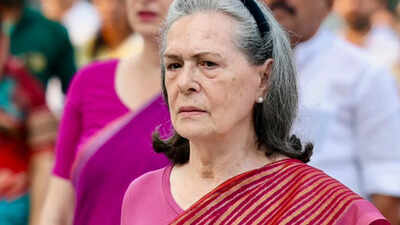

NEW DELHI: Congress Parliamentary Party (CPP) Chairperson Sonia Gandhi has accused the Bharatiya Janata Party (BJP) government of causing significant damage to India’s democratic institutions over the past 12 years, expressing confidence that the country’s electorate would eventually bring about a return to proper governance.In an interview with The Hindu, Sonia said the damage extended to the country’s democratic fabric and institutions, adding that people were increasingly recognising the consequences of the government’s actions.“Over the last twelve years, great damage has been done to the fabric of our country, our democracy and our institutions,” she said.She expressed optimism about the country’s political future, while acknowledging that restoring democratic institutions and governance would require considerable time and effort, even after the present government leaves office.“Even after this government goes, it will take time to restore our systems to health, and great effort from political parties. People are now beginning to be restless and recognising the damage. But I am optimistic, and I know that the people of India will welcome a return to proper governance,” she said.Sonia Gandhi on the 1975 EmergencyReflecting on the 1975 Emergency imposed by former Prime Minister Indira Gandhi, Sonia Gandhi acknowledged that democratic rights had been curtailed during the 21-month period but said the decision was taken constitutionally.“It was only after the Emergency that I came to know the true gravity of what had been happening. Yes, democratic rights had been curtailed, and there was a suspension of habeas corpus, but it was done constitutionally,” she said.She also offered her perspective on the circumstances leading to the imposition of the Emergency, referring to violent protests, attacks on government offices and public transport, widespread unrest and calls for the bureaucracy and armed forces to disobey orders.Also read: Court allows more evidence in Sonia Gandhi voter list case“Yet, when I take myself back to that period and try and see it from Mrs Gandhi’s (Indira Gandhi) point of view, I see her struggling to cope with the rapidly deteriorating prevailing circumstances: violent protests, government offices and public transport set on fire, widespread organised unrest and even a call for the bureaucracy and armed forces to disobey orders,” she said.Sonia further noted that Indira Gandhi eventually recognised the situation, called for general elections in March 1977 and later publicly acknowledged and apologised for the excesses committed during the Emergency.“Hindsight allows us to put things better in perspective. Let’s not forget that it was Mrs Gandhi herself who came to recognise what was happening and called for the March 1977 election. And you know very well that she herself later publicly expressed regret and apologised for excesses during the Emergency,” she said.Meanwhile, the BJP hit back at Sonia Gandhi over her criticism of the central government, with Union Law Minister Arjun Ram Meghwal invoking the 1975 Emergency and questioning her remarks on democracy.Speaking to reporters in Bikaner, Rajasthan, Meghwal said Gandhi should also recall the period when democratic rights were curtailed, opposition leaders were jailed and journalists were silenced.“The article makes certain observations regarding democracy. I would like to ask Sonia ji: does she not recall the period of 1975, when democracy was strangled? Thousands of senior leaders from various political parties were thrown into jail, and the voices of journalists were silenced. She ought to remember that era as well. In contrast, over the last 12 years, PM Modi has nurtured, flourished, and strengthened democracy, proclaiming to the entire world that India is the ‘mother of democracy.‘ It is Prime Minister Narendra Modi who has emphatically declared that ‘India is the mother of democracy,'” he said.Responding to the opposition’s demand for a special parliamentary session, Meghwal said the government was ready for a debate and urged opposition parties to submit a proposal. He also referred to the Home Minister’s remarks at a rally in Haryana, saying Parliament was the appropriate forum for such discussions.“Our Home Minister provided a fitting response (to Rahul Gandhi) at a rally in Haryana, pointing out that the Constitution-makers designated Parliament as the proper venue for such debates. If the opposition wishes to engage in a discussion, let them put forward a proposal; we can certainly convene a special session—there is no issue with that. The Prime Minister has also expressed a similar sentiment. As for the suggestion that someone should act as a ‘judge’—our democratic system already has a mechanism for this; the Speaker serves as the arbiter. What is new about this proposal? Why not simply debate? Who is stopping them? They have written requesting a special session; the government is prepared to call one. We are ready for a debate,” he said.Sonia Gandhi’s memoir ‘Belonging: A Journey of Love’The Congress leader also spoke about her upcoming memoir, Belonging: A Journey of Love, describing it as an account of how she grew to love her husband and former Prime Minister Rajiv Gandhi’s family and India, and how that connection eventually brought her into public life.In the interview, she said she had long been reluctant to share her personal story but eventually decided to write about the experiences that shaped her life and her decision to enter politics.“I had no desire to talk about it for so long. But it is not only a love story between the two of us, but it’s also the story of how I grew to love Rajiv’s family and the country to which they belonged, and then I too came to belong in it. And of how this love brought me into public life, when I saw the purpose of all the sacrifices they had made being threatened, and the party was weakening. I felt I had to do something,” she said.The memoir traces Sonia’s journey from her childhood in post-war Italy and her romance with Rajiv Gandhi, which brought her to India, to the personal losses that shaped her life and her relationship with her adopted country. It also recounts her experiences as a member of the Nehru-Gandhi family and her journey from private life to public service.The book, her first memoir, is scheduled to be launched on November 10.Rahul Gandhi expresses pride over mother’s memoirEarlier, Leader of Opposition in the Lok Sabha Rahul Gandhi had expressed his excitement over the publication of his mother’s memoir, saying he was proud that her personal story would reach readers.
Join conversation
Share your thoughts in the comments
Be respectful · TOI community guidelines
On the 82nd birth anniversary of his father, Rajiv Gandhi, Rahul said he understood how difficult it had been for his mother, who preferred to maintain a private life, to share her experiences publicly.“I am happy, and so proud, that your story–‘Belonging: A Journey of Love’–will finally be read by the millions of people who love you. I know how hard it was for someone as private as you to tell the world your beautiful story. Today, on his birthday, I can see Papa smiling and looking down proudly at his beautiful Sonia,” Rahul Gandhi said.