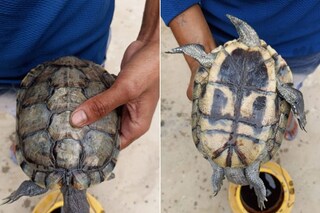


With its vibrant colours and captivating golden hue, the Red Eared Slider makes for a popular pet in America and Mexico. (Photo/News18)
Environmentalists and animal experts consider the Mexican Giant Turtle the most destructive among the seven turtle species found in the world. Its scientific name is ‘Trachemys scripta elegans’ and it is known for the bright red circular or oblong spots near its ears
Much to the surprise of animal experts, the Mexican Giant Turtle, also known as the Red Eared Slider was found in West Bengal’s Howrah district. Native to Mexico, South America, and the Mississippi River, its appearance in the Bengal region has puzzled the experts.
With its vibrant colours and captivating golden hue, the Red Eared Slider makes for a popular pet in South America.
It was discovered in South Malancha Beria of Shyampur reservoir in the Howrah district by the forest staff of the 58 gate range. Experts estimated the rescued turtle to be one year old.
Is Red-Eared Slider Harmful?
Environmentalists and animal experts consider the Mexican Giant Turtle the most destructive among the seven turtle species found in the world. Its scientific name is ‘Trachemys scripta elegans’ and it is known for its bright red circular or oblong spots near its ears.
Zoologists suggest that this turtle species may have originated in the Middle Jurassic period, evolved from Testudians and gradually adapted into today’s red-eared sliders. They inhabit ponds, small water bodies, and freshwater lakes and can adapt to any environment quickly. Fish and other aquatic animals struggle to survive in areas inhabited by these turtles.
Their physical growth is rapid courtesy of their voracious diet. One of the subspecies of the Red Eared Slider is the snapping turtle, which can weigh up to 100 kg.
A carrier of the Salmonella bacteria, this species poses a threat to both aquatic animals and humans. Salmonella infection can lead to diarrhoea, abdominal pain, vomiting, and fever. Long-term effects can cause metabolic cell damage in the human body, with potentially disastrous consequences.
The first Red Eared Slider was spotted in Bengal in 2015 in a Rajarhat reservoir. Another was seen in Rabindra Sarovar five years later in 2020. This is the third time the Red-Eared Slider has appeared in West Bengal. The turtle was first observed in India in Kerala’s Kolthode canal, where the Kerala Forest Research Institute rescued and monitored it.
Read all the Latest India News here