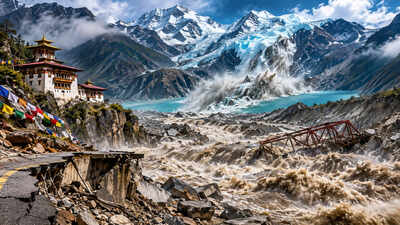

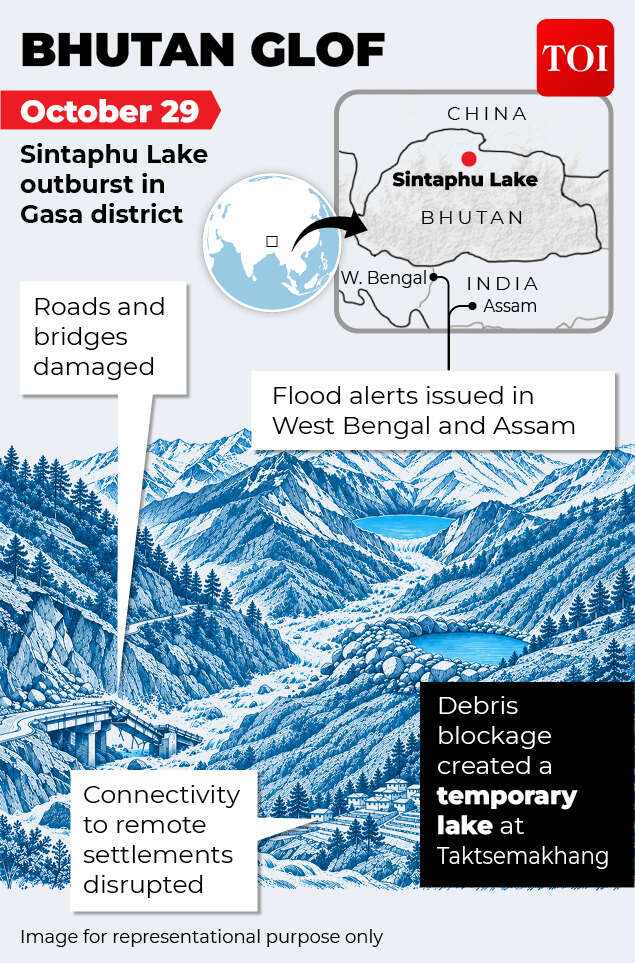
Bhutan’s glacial lake outburst has exposed a growing threat facing the Himalaya, where retreating glaciers, expanding glacial lakes and increasingly unstable mountain terrain are raising the risk of sudden, cascading disasters.The October 29 outburst from Sintaphu Lake in the country’s Gasa district sent a torrent of water and debris downstream, damaging roads and bridges, disrupting connectivity to remote settlements and triggering flood alerts in parts of India’s West Bengal and Assam.The situation took a more concerning turn when debris from the flood obstructed a downstream river channel, creating a temporary lake at Taktsemakhang and raising fears of a possible secondary flood.Although no casualties were reported, the incident has brought the vulnerability of Himalayan communities and critical infrastructure into sharp focus. Beyond the immediate damage, it has raised a larger question: are countries sharing Himalayan river systems prepared for the cascading disasters that a rapidly changing mountain environment could trigger?
One flood, another potential disaster
The danger did not end with the initial outburst. As the floodwaters travelled downstream, they carried large quantities of rocks, soil and sediment, which accumulated at the confluence of Sintaphu Chhu and Lungu Chhu, also known as Gangchen Tag Chhu.The resulting blockage caused water to accumulate at Taktsemakhang in Bhutan’s Gasa district, creating a temporary lake and raising concerns about another possible flood.The formation of such temporary lakes is a known secondary hazard associated with glacial lake outburst floods (GLOFs). Powerful floodwaters can erode river valleys and deposit large volumes of debris downstream, creating natural barriers that obstruct river channels. If these blockages weaken or collapse, the accumulated water can be released suddenly, triggering another potentially devastating flood.As of November 2, the temporary lake was reported to be stable, with no noticeable rise in water levels and its outflow remaining constant. Bhutanese authorities were monitoring the site, while controlled explosions were being considered to facilitate the drainage of accumulated water.However, a subsequent report by Bhutan Broadcasting Service on November 3 said a substantial volume of water remained in the upper lake. The possibility of another outburst had not been ruled out, although authorities were yet to verify the situation through a physical inspection. The precise trigger of the October 29 outburst also remained unconfirmed.
Melting glaciers raise Himalayan disaster risks
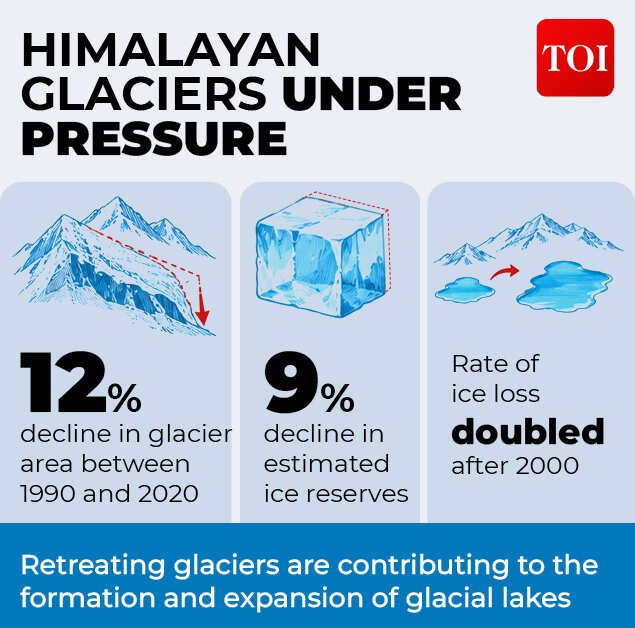
The Bhutan outburst is part of a wider environmental shift unfolding across the Hindu Kush Himalaya, where rising temperatures are accelerating glacier loss and transforming the region’s high-altitude landscape.As glaciers retreat, meltwater collects in depressions left behind by the ice, forming new glacial lakes or causing existing ones to expand. Many of these lakes are held back by natural barriers of loose rocks, soil and glacial debris, known as moraines. These barriers are vulnerable to erosion, slope instability and the impact of avalanches or landslides entering the lake. A breach can release enormous volumes of water downstream, triggering a GLOF.The scale of this transformation is reflected in a 2026 assessment by the International Centre for Integrated Mountain Development (ICIMOD). It found that glaciers across the Hindu Kush Himalaya lost around 12 percent of their total area and 9 percent of their estimated ice reserves between 1990 and 2020. The rate of ice loss doubled after 2000.Speaking to TOI, Dr Rijan Bhakta Kayastha, visiting senior professor at the Department of Environmental Science, Kathmandu University, said rising temperatures at higher elevations were accelerating glacier melt and destabilising mountain slopes.“Due to higher air temperature at higher elevation in recent years, old permafrost are melting and ground or slopes are destabilized. In such cases, a huge slope may collapse into a lake and GLOF can initiate,” he said.He added, “Due to high ice melting supra-glacier ponds/lakes may drain water through englacial channels releasing a huge amount of water causing a devastating flood in the downstream.”Referring to Bhutan’s October 29 outburst, Kayastha said, “The cause of the GLOF has not been identified yet, but high ice melting due to higher air temperature and sudden release of huge meltwater from the mother glacier cannot be ruled out.”
A Bhutan study reveals the scale of the threat
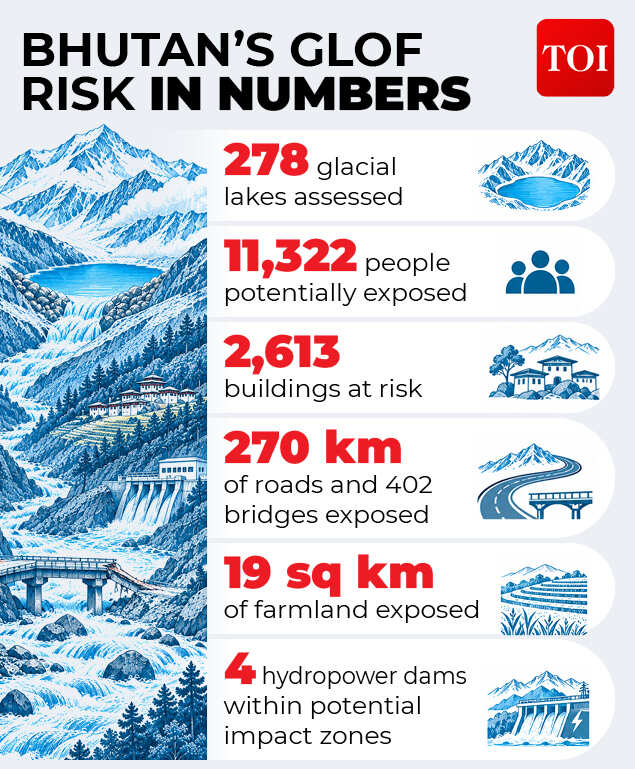
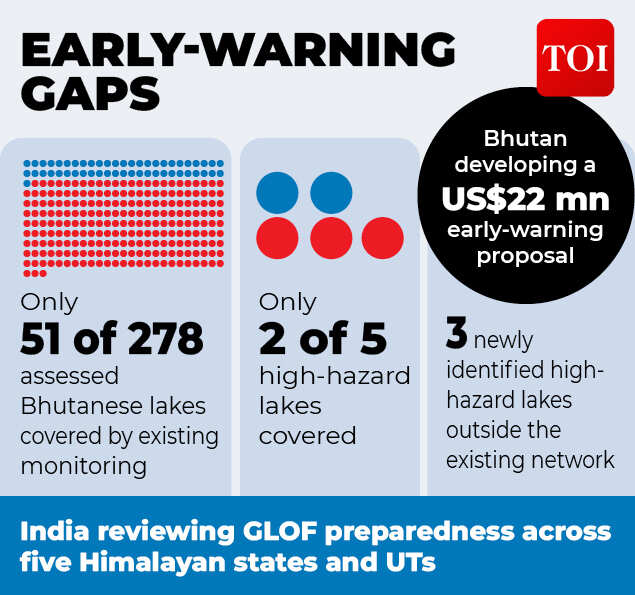
The potential scale of the danger is highlighted in a study published in the journal Natural Hazards and Earth System Sciences in March 2026. Researchers modelled possible glacial lake outburst floods from 278 lakes in Bhutan, each covering more than 0.05 square kilometres and located within one kilometre of a glacier.The study found that potential GLOFs could expose 11,322 people, 2,613 buildings, 270 kilometres of roads, 402 bridges and 19 square kilometres of farmland to flooding. Four hydropower dams were also identified within potential impact zones.The researchers classified Thorthormi Tsho as a very-high-hazard lake and identified five others as high hazard. Three of these — Phudung Tsho, lake251 and Wonney Tsho — had not been classified as high hazard in earlier assessments.The study also highlighted significant gaps in Bhutan’s early-warning network. Of the 278 lakes assessed, only 51 were covered by the existing monitoring system. This included Thorthormi Tsho and just two of the five high-hazard lakes, leaving three newly identified high-hazard lakes outside the monitoring network.The findings are based on computer simulations of hypothetical flood scenarios, not predictions that these lakes will burst. Nevertheless, they underline why assessing a lake’s danger must go beyond its size or the likelihood of a breach. The communities and infrastructure exposed downstream are equally important considerations.
Hydropower infrastructure faces a major risk
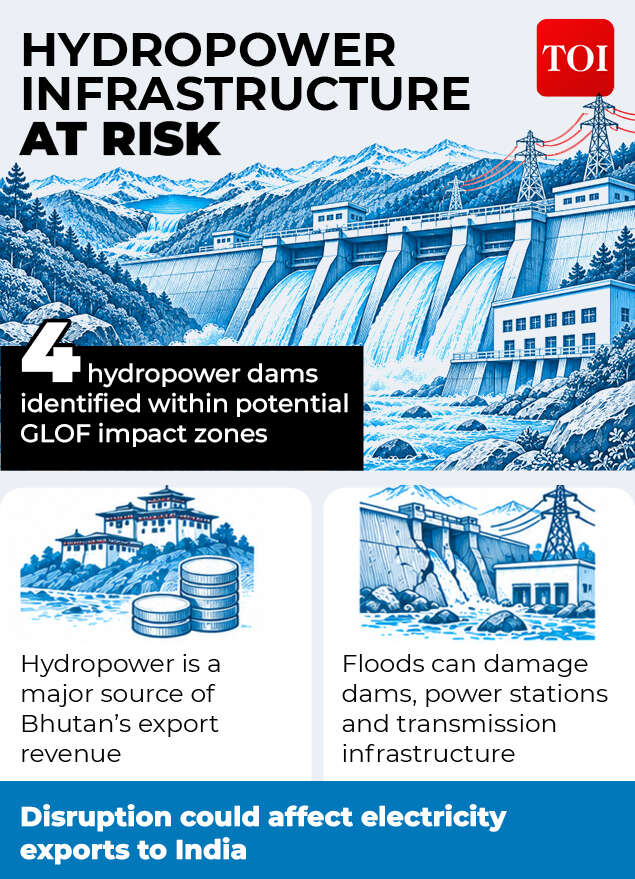
The threat extends beyond villages, roads and bridges. Bhutan’s economy is heavily dependent on hydropower, with major power projects located along rivers fed by glaciers in the northern mountains.A severe GLOF could send enormous volumes of water, rocks and sediment downstream, threatening dams, power stations, transmission links and other critical facilities. Damage to these assets could disrupt electricity generation and affect power exports to India.The 2026 study identified four hydropower dams within potential GLOF impact zones. It also highlighted the exposure of roads, bridges and settlements along glacier-fed river valleys, underlining how a single outburst could affect multiple parts of the infrastructure network.For Bhutan, where hydropower is a major source of export revenue, the consequences could extend well beyond the immediate impact of floodwaters on dams. Damage to access roads, transmission infrastructure and other connected facilities could also disrupt the functioning of power projects.Dr Rijan Bhakta Kayastha stressed the need for hydropower developers to assess risks across entire river basins before undertaking projects.“Hydropower developers should study the whole river basin before they initiate their project, and precautional measures should be taken for huge glacial floods,” he said.The challenge, therefore, is not simply to protect individual dams. It is also to ensure that warnings reach downstream communities in time, access roads remain functional and emergency plans account for damage across interconnected infrastructure.
India faces risks beyond its Himalayan states
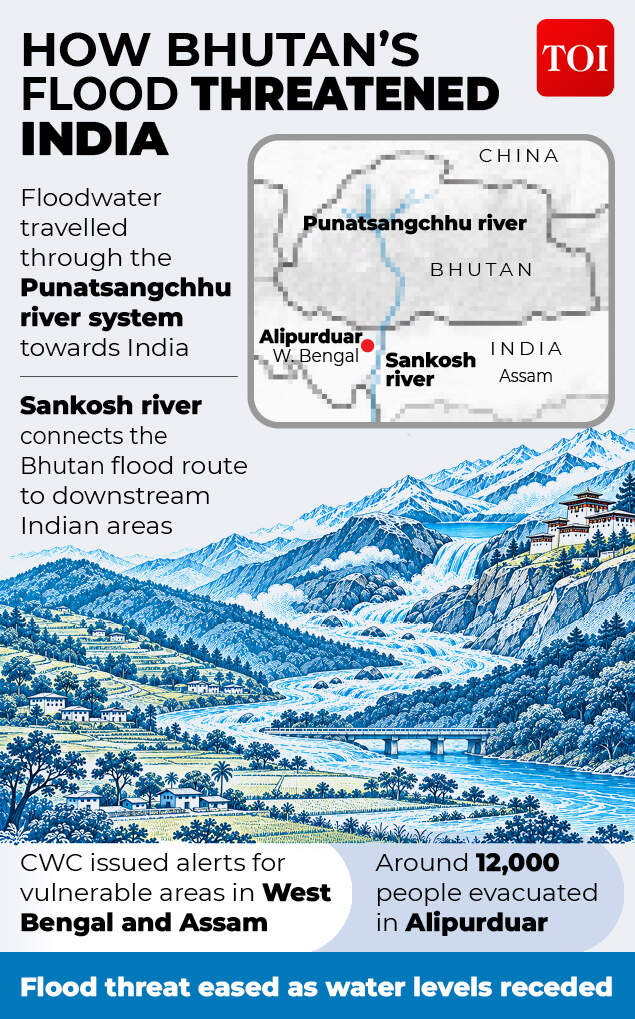
The threat posed by glacial lake outburst floods does not stop at national borders. Rivers originating in the Bhutan Himalaya flow into India, carrying the potential impact of a sudden outburst far downstream.The October 29 incident demonstrated this vulnerability. The Central Water Commission (CWC) warned that floodwaters moving through the Punatsangchhu river system, known as the Sankosh in India, could reach the border within six to eight hours. Alipurduar in West Bengal and Dhubri in Assam were identified as areas potentially at risk.The warning prompted evacuations in vulnerable parts of north Bengal, while authorities in Assam monitored the situation along the Sankosh. Around 12,000 people were moved to safer locations in Alipurduar district. Although the immediate threat later eased, the episode showed how a disaster originating in Bhutan could put communities across the border at risk within hours.India has already experienced the destructive consequences of such events. In October 2023, the breach of South Lhonak Lake in Sikkim triggered a devastating flood in the Teesta river, causing the collapse of the Teesta-III hydropower dam and extensive damage downstream. The Central Water Commission documented the event as a major GLOF-related flood.Together, the Bhutan and Sikkim incidents underline the vulnerability of communities and infrastructure along Himalayan river systems. They also demonstrate why disaster preparedness cannot be confined to the country in which a glacial lake is located.
Early-warning systems remain critical to saving lives
The growing threat of GLOFs has placed early-warning systems and evacuation preparedness at the centre of disaster management across the Himalaya.Monitoring glacial lakes can help authorities identify potential dangers, but surveillance alone is not enough. Reliable forecasting, rapid communication and clearly defined evacuation plans are equally critical to ensuring warnings reach vulnerable communities before floodwaters arrive.Bhutan’s early-warning network in the Punatsangchhu basin became operational in the Pho Chhu sub-basin in 2011 and was expanded to the Mochhu sub-basin in 2013. However, the 2026 Bhutan study’s finding that only 51 of the 278 lakes assessed were covered by the existing monitoring network highlights the limitations of current surveillance.Bhutan is now working to strengthen its warning infrastructure. In September 2026, Prime Minister Tshering Tobgay said the existing systems were functioning but had become old and needed improvement. The government was developing a proposal to expand early-warning coverage across the country’s major river basins. A concept note worth US$22 million had been approved by the Green Climate Fund in June 2026, with a full proposal being developed in collaboration with the United Nations Environment Programme.India, meanwhile, has begun reviewing preparedness across its Himalayan states. In September 2026, Union Home Secretary Govind Mohan chaired a meeting with officials from five Himalayan states and Union territories to assess glacial lake monitoring, warning mechanisms, evacuation plans and disaster-response arrangements.Dr Rijan Bhakta Kayastha said Himalayan countries were not adequately prepared for increasingly unpredictable glacial floods.“Most of the Himalayan nations are not well prepared for such uncertain glacial floods. All are concentrating on bigger glacial lakes in the past but now from the Bhotekoshi-Trishuli and Budhigandaki Glacial disasters, we need to monitor and watch carefully all high elevation glaciers and hanging glaciers, too,” he said.He called for a much wider monitoring network, saying, “Therefore, we need to monitor all glaciers at high elevation, hanging glaciers, large snow fields, glacial lakes, permafrost zones and rivers flowing from glacierized river basins using satellite data, automatic weather stations, water level sensors, field cameras and seismic sensors for robust early warning system.”
A regional threat needs a regional response
The Bhutan outburst has shown how quickly a disaster in the high mountains can cross borders, disrupt critical infrastructure and threaten communities far downstream. With glaciers retreating and glacial lakes expanding across the Hindu Kush Himalaya, the danger is no longer confined to isolated mountain valleys.For India, Bhutan and other countries sharing Himalayan river systems, the priority must be stronger cross-border coordination, regular monitoring of vulnerable lakes, reliable early-warning networks and evacuation plans that account for cascading hazards.
Join conversation
Share your thoughts in the comments
Be respectful · TOI community guidelines
Hydropower projects and other critical infrastructure must also be assessed against the changing risks posed by glacial floods.The challenge is not simply to prevent every glacial lake from bursting, an outcome that may not be possible. It is to ensure that when an outburst occurs, authorities have enough time, information and coordination to limit its impact. As the Himalayan landscape continues to change, preparedness is no longer just a national responsibility. It is a regional necessity.