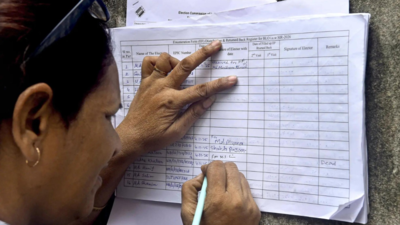

NEW DELHI: Election Commission on Tuesday allowed previously enrolled voters whose names were deleted from the draft electoral rolls during the Special Intensive Revision (SIR) to submit Form 6 to seek their inclusion in the final list.In a letter to all state chief electoral officers, the poll body said it had received reports that some voters were hesitant to submit Form 6 because it requires applicants to declare that their names are being included in the electoral rolls for the first time.“Therefore, such electors believe that submission of Form 6, in view of their previous enrolment, would amount to making a false declaration and render them liable for prosecution under Section 31 of the Representation of the People Act, 1950,” it said.The EC’s clarification comes days after the Supreme Court said that no one would be prosecuted for using Form 6 to get their names included in the electoral rolls again.The observation was made by a bench of CJI Surya Kant and Justices Joymalya Bagchi and V Mohan while hearing a PIL challenging the large-scale exclusion of names from Maharashtra’s draft electoral roll. The bench was responding to senior advocate Aravind Datar’s submission that using Form 6 for re-inclusion would amount to making a false declaration under oath.“No one will be prosecuted for filling Form 6 seeking re-entering of their names in voter lists,” the CJI said.The bench also said, “If we find, even after the publication of the final electoral roll, that there are people who are genuine voters but still excluded, we can extend time for them to submit documents for the purpose of re-entering their names in voter lists.”
Join conversation
Share your thoughts in the comments
Be respectful · TOI community guidelines
What is Form 6?Form 6 is the application through which an eligible person seeks inclusion of their name in the electoral roll. According to the Election Commission’s guidelines, the application is addressed to the Electoral Registration Officer of the constituency where the applicant ordinarily resides.The form requires basic details such as the applicant’s name, details of a relative, Aadhaar information, gender, date of birth and present ordinary residence. Applicants are also required to complete a declaration. The guidelines warn that making a false statement in the declaration is punishable under Section 31 of the Representation of the People Act, 1950.