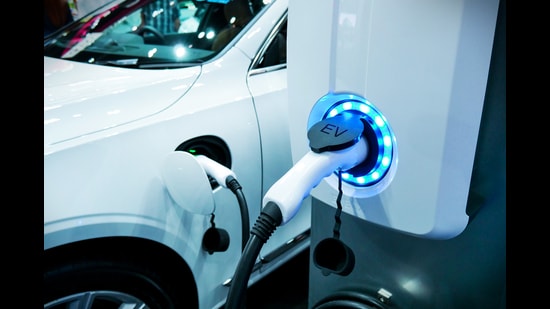

Despite a vigorous push from the local administration, only 5.64% electric vehicles (EVs) were sold in Chandigarh compared to fuel-based vehicles over the last five years.
This was revealed through data presented in the Rajya Sabha by Bhupathi Raju Srinivasa Varma, minister of state for heavy industries and steel, on Friday.
Sharing further details with the Parliament, he stated that a total of 2,19,391 vehicles were sold in Chandigarh between April 1, 2019, and March 31, 2024. Among these, the number of EVs stood at 12,375 — accounting for just 5.64% of the total vehicle sales.
Of the 12,375 EVs sold, 3,690 were two-wheelers, 6,731 three-wheelers, 1,799 four four-wheelers and 155 light passenger vehicles.
UT fourth in country in EV adoption
According to the data, Chandigarh ranks fourth in the country in terms of EV share among total vehicle sales. Leading the list is Delhi, with the highest EV adoption at 7.72%, followed by Goa at 6.28%, Assam at 5.79% and Tripura at fifth place with 5.62%.
The UT administration had rolled out a five-year EV policy in September 2022, aiming to gradually stop registering fuel-based vehicles to discourage their use and reduce pollution. This was part of a larger plan to make Chandigarh a “Model EV City” by achieving one of the highest penetrations of zero-emission vehicles by 2027.
However, on November 23 last year, under pressure from various quarters, the then UT administrator Banwarilal Purohit lifted the cap on registering non-electric vehicles, including two-wheelers, four-wheelers and commercial vehicles.
Ram Kumar Garg, finance secretary of the Federation of Automobile Dealers’ Association, Chandigarh, said, “The maintenance cost of electric vehicles, particularly for batteries, is very expensive. Also, why would people buy electric vehicles when there is no proper public charging infrastructure? The administration has failed to operationalise most of its charging stations, raising buyers’ worries about where they will charge their vehicles.”
Incentives sufficient to boost EV adoption?
As part of its EV policy, to promote eco-friendly vehicles, the administration has waived registration fees and road tax for five years. In contrast, owners of conventional fuel-based vehicles are required to pay both. Additionally, incentives ranging from ₹3,000 to ₹2 lakh are being offered for up to 42,000 vehicles of various categories, including 25,000 e-cycles, 10,000 e-bikes, and 3,000 e-cars, purchased between September 20, 2022, and September 19, 2027.
The incentives are applicable for EVs purchased anywhere in the country, but only permanent residents of Chandigarh are eligible. In May last year, the UT administration further exempted hybrid vehicles, along with electric vehicles, from paying road tax for the next five years.
UT to get 100 electric buses under PM e-bus service scheme
Meanwhile, in reply to a question in the Lok Sabha, Tokhan Sahu, minister of state for housing and urban affairs, stated that the ministry had sanctioned 100 electric buses under the PM–eBus Sewa Scheme for Chandigarh.
To another question raised in the Rajya Sabha, HD Kumaraswamy, minister for heavy industries, stated that an amount of ₹11.87 crore was sanctioned and released for Chandigarh. Under the PM-eBus Sewa Scheme, 100% Central Assistance (CA) is provided for development of “Behind-The-Meter” power infrastructure, he added.
In Chandigarh, all buses of the transport department will be converted into electric buses by 2027-28. Although earlier there was a proposal to convert some buses into CNG, it was found that it will cost more, due to which the proposal was cancelled by the transport department itself.
Currently, CTU has a total of 80 electric buses that ply on local routes. If the administration gets more buses, then in the coming time, the entire fleet will be electric.