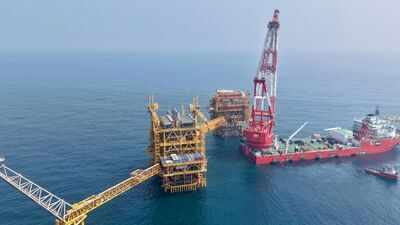

India is taking its search for oil and natural gas deeper into the sea.The focus is now spread across the Mahanadi basin off Odisha, the frontier waters of the Andaman-Nicobar region, and deeper sections of the Krishna-Godavari and Cauvery basins. The government’s latest assessment puts the hydrocarbon potential of India’s eastern and western offshore basins at more than 5,600 million metric tonnes of oil equivalent (MMTOE), with water depths extending to 3,000 metres.Recent discoveries in the Cauvery, Mahanadi and Andaman basins have strengthened the case for expanding offshore exploration.The push comes as India remains heavily dependent on imported energy. India is the world’s third-largest consumer of crude oil and has an annual crude oil import bill of nearly $144 billion, or about ₹13 lakh crore, according to the government.There is another problem. Existing oil and gas fields naturally decline by around 6 to 7 percent each year. New discoveries are therefore essential to sustain domestic production.
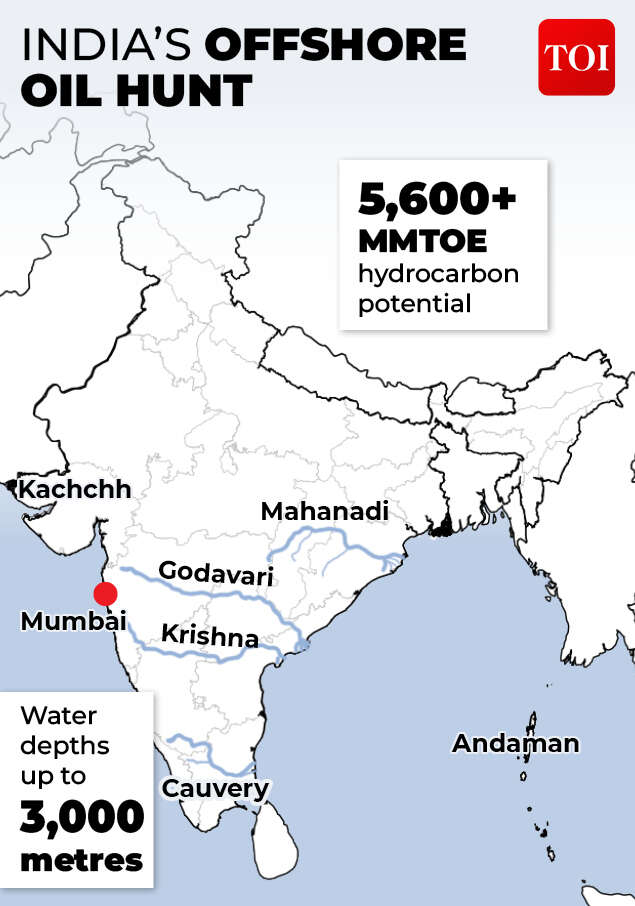
India’s offshore oil hunt
From PM Modi’s 2025 announcement to Samudra ManthanThe current push is the latest stage of a decade-long effort to reshape India’s upstream oil and gas sector.The government introduced the Hydrocarbon Exploration and Licensing Policy (HELP) in 2016 and launched the Open Acreage Licensing Programme (OALP). It also moved from Production Sharing Contracts to Revenue Sharing Contracts and expanded the National Data Repository.The government subsequently opened almost 99 percent of the offshore areas earlier classified as “No-Go” for exploration. This made more than one million square kilometres of India’s Exclusive Economic Zone available for exploration.Prime Minister Narendra Modi gave the next phase a mission-mode identity in his Independence Day address on August 15, 2025.Calling the effort a modern-day “Samudra Manthan”, PM Modi said India would work in mission mode to find oil and gas reserves beneath the sea. He also announced the National Deep Water Exploration Mission.On July 31, 2026, the Union Cabinet approved Samudra Manthan, the National Offshore Exploration Scheme. The central sector scheme, under the Ministry of Petroleum and Natural Gas, has an outlay of ₹84,084 crore through financial year 2030-31.The scheme allocates ₹28,534 crore for offshore seismic data acquisition, processing and interpretation, and ₹43,200 crore for 60 deepwater and ultra-deepwater exploration wells.The government will support up to 50 percent of eligible drilling costs, subject to a ceiling of ₹675 crore per well. The scheme also provides ₹10,000 crore for common offshore infrastructure, ₹2,000 crore for oil and gas manufacturing and services zones, and ₹350 crore for monitoring and support activities.But the real test of Samudra Manthan lies beneath the numbers.It is about where India is drilling, what it has already found, and whether those discoveries can eventually become producing fields.
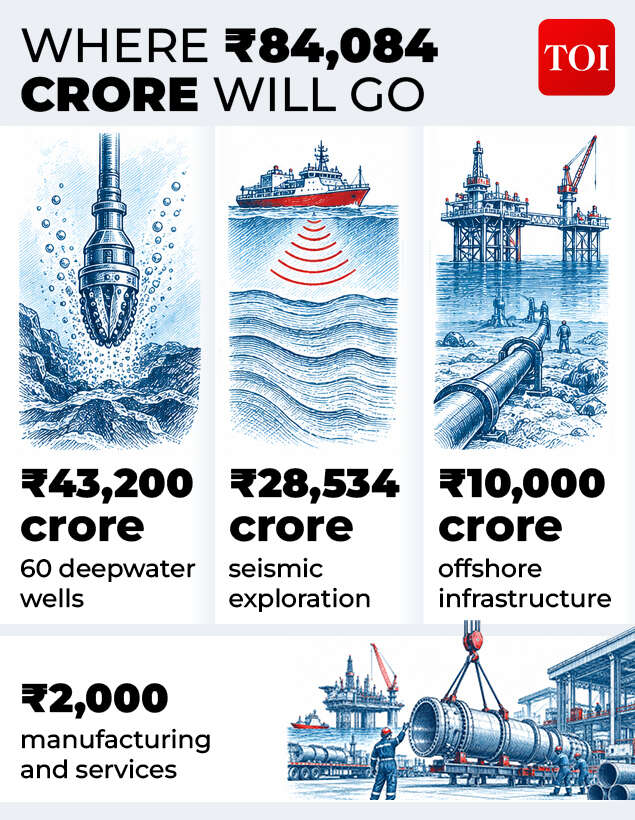
Where Rs 84,084 crore will go
Mahanadi is the immediate deepwater testThe Mahanadi Offshore Basin off Odisha is one of the most important tests of India’s deepwater strategy.On July 25, Petroleum and Natural Gas Minister Hardeep Singh Puri marked the start of drilling of MN-DWN18-1-HD, the first appraisal well in the Mahanadi Offshore Basin.It is the first of four planned deepwater wells intended to systematically evaluate the basin, which the government considers one of India’s most prospective offshore areas.An appraisal well is drilled to determine the quality and commercial potential of an existing hydrocarbon discovery. The four-well programme is therefore an important step beyond seismic interpretation. It is designed to establish how significant the basin’s discoveries could actually be.Government records show that ONGC had already made two gas discoveries in the Mahanadi offshore area after the opening of the former No-Go zones. One of these was in a block where 94 percent of the area had earlier been classified as No-Go.But finding hydrocarbons is only the first step.The Mahanadi basin also highlights why Samudra Manthan includes a major infrastructure component. The government says several offshore discoveries remain undeveloped because production and evacuation costs are too high, particularly in the Mahanadi and Kutch basins.The scheme’s ₹10,000 crore common infrastructure component is aimed at tackling that problem.
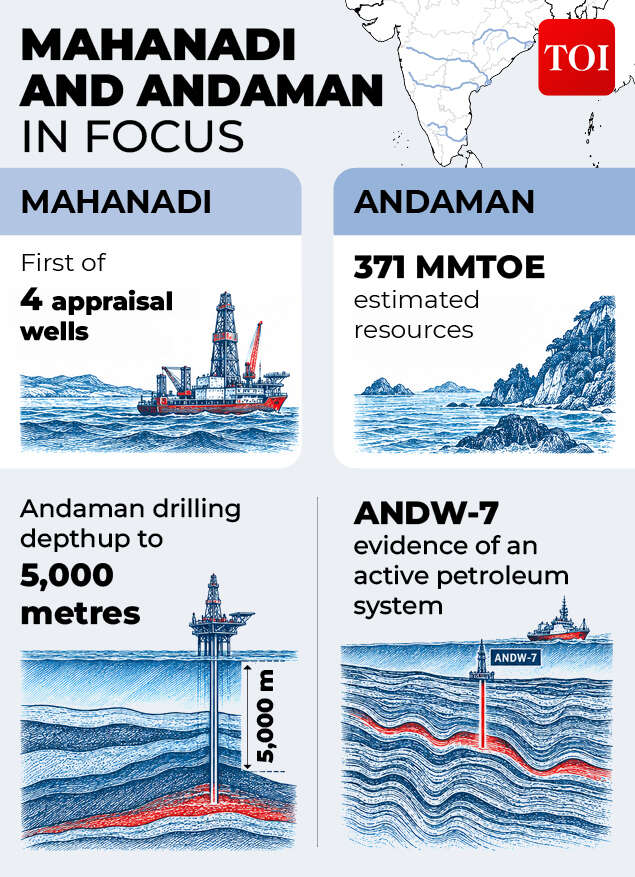
Mahanadi and Andaman in focus
Andaman is the frontier huntFurther east, the Andaman-Nicobar offshore basin represents a more frontier form of exploration.The government’s 2017 Hydrocarbon Resource Assessment Study estimated hydrocarbon resources in the Andaman-Nicobar basin at 371 MMTOE. Following HELP, four blocks covering approximately 23,261 square kilometres were allocated for oil and gas exploration. Government data says exploration in those blocks generated 8,501 line kilometres of 2D seismic data, 3,270 square kilometres of 3D seismic data and three drilled wells.Another four blocks covering 47,058 square kilometres were subsequently offered in the Andaman basin under OALP-X.ONGC and Oil India have taken exploration into the ultra-deepwater region, with drilling operations targeting depths of up to 5,000 metres.One important well is ONGC’s ANDW-7 in the East Andaman Back Arc region. The well encountered traces of light crude and condensate in cutting samples, C-5 neo-pentane in trip gases and reservoir-quality facies. The government said the findings provided evidence of an active thermogenic petroleum system in the region, comparable with petroleum systems in Myanmar and North Sumatra.The findings do not establish a commercially producing field. The government has said commercial reserves in the Andaman campaign remain to be established. Their significance lies in providing evidence of a working petroleum system that can guide further exploration.Krishna-Godavari is pushing deeperThe Krishna-Godavari basin off India’s eastern coast is a more established offshore hydrocarbon province but remains central to the country’s deepwater strategy.In OALP Round VIII, the 2022 KG-UDWHP-2022/1 ultra-deepwater block in the Krishna-Godavari basin covered 1,199.64 square kilometres. This was the size of that particular block, not the total current exploration acreage of the basin.The Krishna-Godavari basin has also attracted international technical collaboration. In 2022, ONGC signed a Heads of Agreement with ExxonMobil for deepwater exploration covering the Krishna-Godavari and Cauvery basins on the eastern coast and the Kutch-Mumbai region on the western coast.Cauvery adds another deepwater targetThe Cauvery Offshore Basin is another important part of India’s eastern offshore exploration map.The government’s 2026 Samudra Manthan backgrounder cites recent finds in the Cauvery, Mahanadi and Andaman basins as evidence supporting the broader offshore opportunity.The basin is part of India’s wider effort to identify additional offshore resources through deeper and more technically demanding exploration.The western offshore areas are also part of the planSamudra Manthan is not confined to India’s eastern coast. The western offshore belt, including Kutch and Mumbai Offshore, is also part of the country’s wider exploration strategy.The government has identified Mahanadi and Kutch as areas where common offshore infrastructure is particularly important because high production and evacuation costs can prevent discoveries from moving into production.OALP Round VIII in 2022 included blocks in Mumbai Offshore, Kutch, Saurashtra and Kerala-Konkan. ONGC’s collaboration with ExxonMobil also covered the Kutch-Mumbai region, keeping the western offshore belt within India’s broader deepwater exploration push.From geological potential to actual productionThe numbers attached to Samudra Manthan describe a large opportunity, but they do not mean India already has 5,600 MMTOE of proven offshore reserves waiting to be produced.The government estimates more than 5,600 MMTOE of hydrocarbon potential across India’s eastern and western offshore basins. Separately, subject to exploration success, Samudra Manthan aims to add more than 600 MMTOE of hydrocarbon reserves, expand the country’s hydrocarbon resource base from 1.6 billion tonnes of oil equivalent to 2.2 billion tonnes of oil equivalent, and increase annual domestic oil and gas production from around 62 MMTOE to 80 MMTOE.The government says the additional production could eventually reduce crude oil imports by nearly ₹1 lakh crore a year.The distinction between potential, reserves and production is critical. Seismic surveys identify promising geological structures, but drilling is required to establish whether hydrocarbons are actually present. A discovery then needs appraisal, reserve estimation and commercial assessment before it can move into development and production.
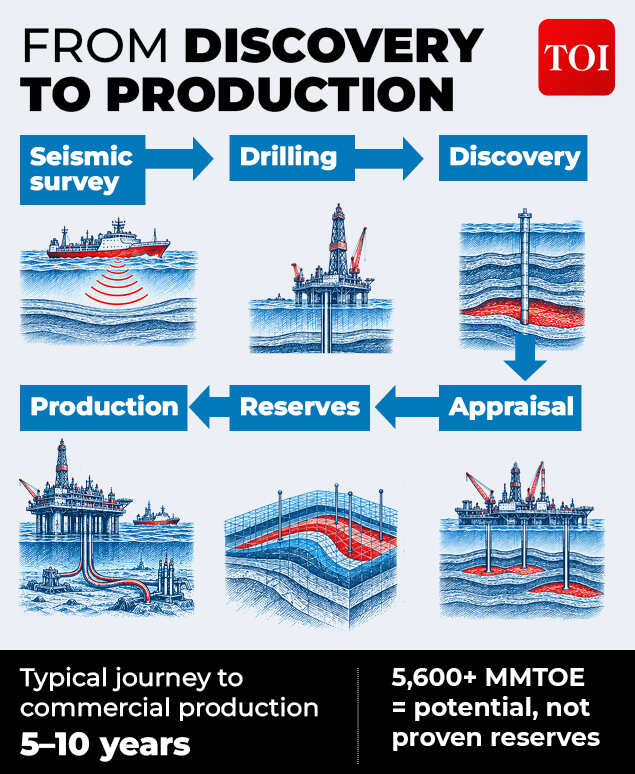
From discovery to production
Samudra Manthan therefore goes beyond drilling. Its ₹84,084 crore framework combines geological data acquisition, deepwater drilling support, common infrastructure, and domestic manufacturing and services capacity.The immediate picture is spread across different stages. Mahanadi is in an appraisal campaign designed to evaluate hydrocarbon discoveries. Andaman remains a frontier basin where geological evidence points to an active petroleum system, but commercial reserves have yet to be established. Krishna-Godavari and Cauvery remain important eastern offshore targets for deeper exploration, while Kutch and other western offshore areas form part of the wider exploration and infrastructure strategy.Samudra Manthan is therefore not simply India’s ₹84,084 crore plan to drill more wells. It is the latest stage of a decade-long effort to open offshore acreage, improve geological data, encourage exploration and build the infrastructure needed to bring commercially viable discoveries into production.
Join conversation
Share your thoughts in the comments
Be respectful · TOI community guidelines
The decisive test will be whether prospects beneath the Mahanadi, Andaman, Krishna-Godavari, Cauvery and other offshore areas can make the journey from geological potential to commercially recoverable reserves and, finally, to actual oil and gas production in India.