

When 24-year-old Manisha Kesariya is done with cooking, cleaning and other household chores, it is not time for her to start cooking again. Nope. It’s time for the housewife to go to the smart classroom in her village and prepare for her Class 10 exam. She is one of the 21 women steering a revolution in Kutch’s Kunariya village that has the blessings of its elders.They are on a mission to complete their schooleducation so they can be financially independent, and the gram panchayat is going all out to make it happen.
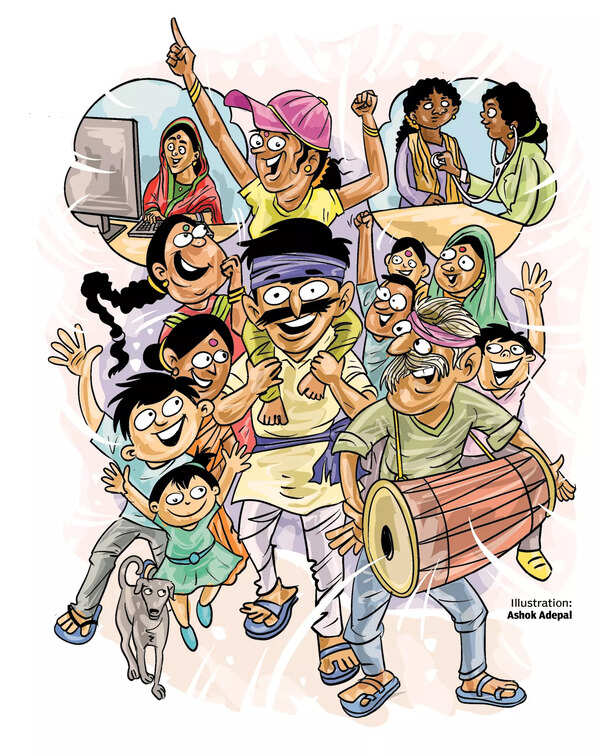
Kunariya’s claim to fame is Bollywood film “Lagaan” which was shot here — the determination shown by Bhuvan, played by Aamir Khan, and his friends has rubbed off on the village elders too. They don’t want to tax their women any further; they want them to live their dreams.
In the age group of 18-27, these women, most of them housewives, had to drop out of school because of social or financial reasons. So, Kunariya’s gram panchayat decided to help them finish their schooling.
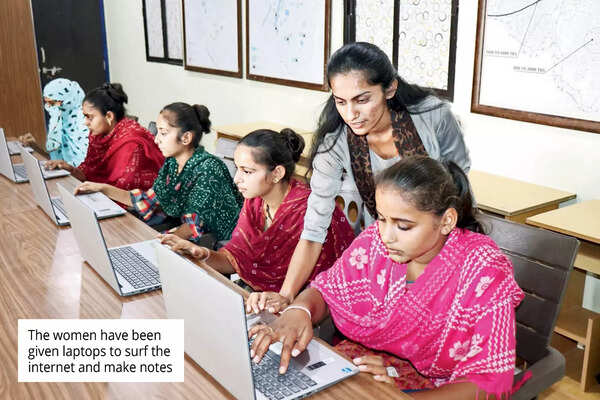
They installed a few computers in their library, set up a smart classroom and convinced teachers at urban schools to teach the housewives. They also procured the necessary study materials and distributed them among the board exam aspirants.
“It’s been more than a decade since I stopped going to school. It feels great to be a student again. My husband is the breadwinner of our family, but I want to be self-reliant. If I clear the Class 10 exam next year, I could take up a job at the anganwadi,” says Kesariya.
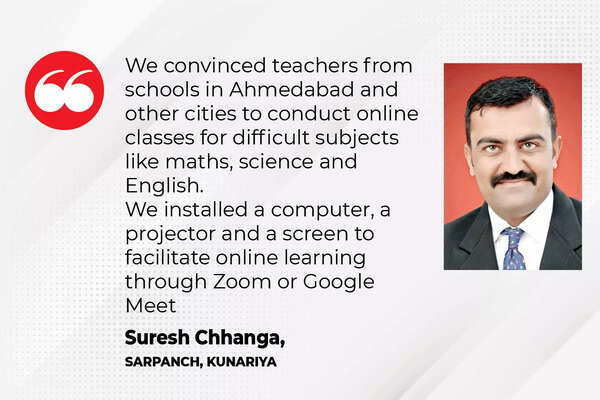
Suresh Chhanga, the sarpanch, says, “Ours is a small village and we don’t have many teachers here. Hence, we convinced teachers from big cities like Ahmedabad to take online classes for difficult subjects like maths, science and English. We installed a computer, a projector and a screen to facilitate online learning through Zoom or Google Meet. This way, the students can also get their doubts cleared by the teachers. We have also set up laptops and PCs to help them prepare notes and surf the net to understand concepts better.”
The panchayat members came up with the idea after the women asked them if they could help them prepare for the boards. According to the locals here, the village only offers primary education and parents don’t allow girls to go to cities or other villages to study further.
Sadiya Luhar, 18, left her studies five years ago in keeping with her family’s wishes. “I always wanted to study but was not allowed to. Now that we have a big group of women preparing for board exams, my parents have no objection and more so because we don’t need to leave the village. I am going to work hard and make my parents proud,” she says. Kunariya panchayat has also invited women from nearby villages to be part of their initiative.
State’s first Siddi woman doctor is spreading smiles
Paul.John@timesgroup.com
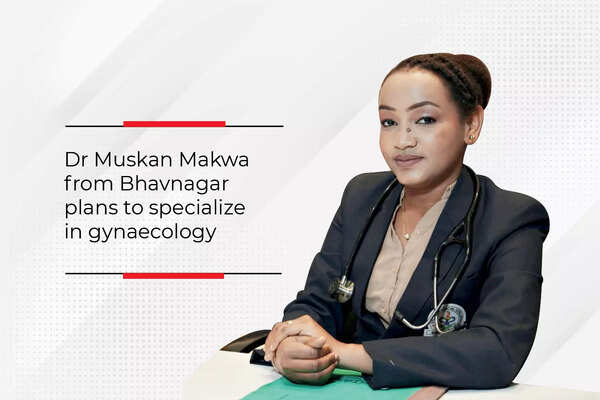
A ‘Dr’ prefix to her name gives 21-year-old Muskan Makwa “a sense of liberty from constraints and the drudgery that comes with poverty”. The first Siddi woman from Gujarat to become a medical doctor, Makwa is a beacon of hope for the marginalized community that has been struggling to break the shackles of indigence.
The Siddis are believed to be descendants of the Bantu tribe of East Africa. According to the 1931 census, the Siddis were brought to Gujarat by the Portuguese as labourers towards the end of the 17th century. A resident of Bhavnagar, Makwa says, “Ever since I was 11, I aspired to become a doctor. I saw that doctors earned a lot of respect and, most importantly, they were never jobless.”
She is currently pursuing a six-month internship and wants to specialize in obstetrics and gynaecology and women’s health and nutrition.
“Gynaecology has always fascinated me. Firstly, you are dealing with two precious lives and then there is this element of women empowerment. I am still awed by how a woman gathers so much strength, patience and courage to endure the pain that comes with childbirth and gives all of herself in raising her child,” says Makwa.
She is determined to stay back in Bhavnagar and serve her community since she understands their needs and constraints. “The stigma that stunts our progress and deprives our children of education and basic healthcare has to go. I want to do a lot for women’s health and nutrition and spread awareness about mental health issues,” she says, adding that education still remains a distant dream for her community.
“Siddi families can’t fund their children’s education. Most of them are daily wagers. Therefore, sending their children to school and giving them emotional support is out of the question. Families want to just marry off girls. It’s a miracle that I was able to become a doctor,” says Makwa, who took no coaching for her boards or competitive exams.
Five years ago, when she cleared the National Eligibility cum Entrance Test (NEET), her father was posted as a gateman with the railways.
Makwa still remembers how proud her community members felt when she got admission to the government medical college in Bhavnagar. “My community has always encouraged me. I was also fortunate that my father got promoted twice in three years and went on to become a train manager. His salary structure improved, and he could fund my education,” she says.
Farida Almubarik, a community elder, beams when she speaks of Makwa. “We have had male doctors, but Dr Muskan Makwa is an inspiration for women. Her decision to work for the women of her community is borne out of the belief that by empowering a woman, two families get empowered; one which she belongs to and the other where she is married off to.”
Hadala’s kho-kho girls have found their feet
Paul.John@timesgroup.com
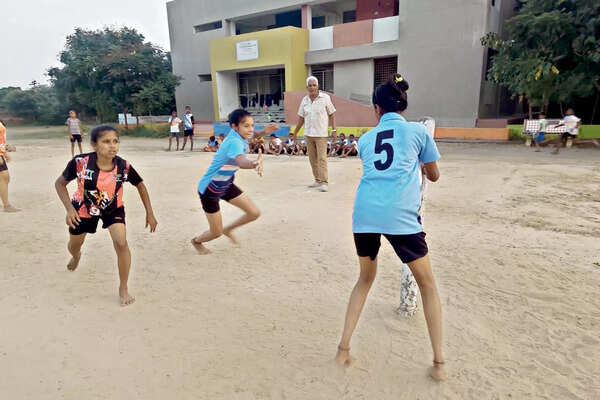
A new generation of champions is rising in Hadala village of Dhandhuka taluka in Ahmedabad district. Children of poor farm labourers, their destinies are engraved not on the palm of their hands, but in the soles of their feet.
Meet Hadala’s girls who are changing the game of kho-kho while crushing barriers. They have been supporting their families with their prize money and grants and also saving up for their wedding expenses.
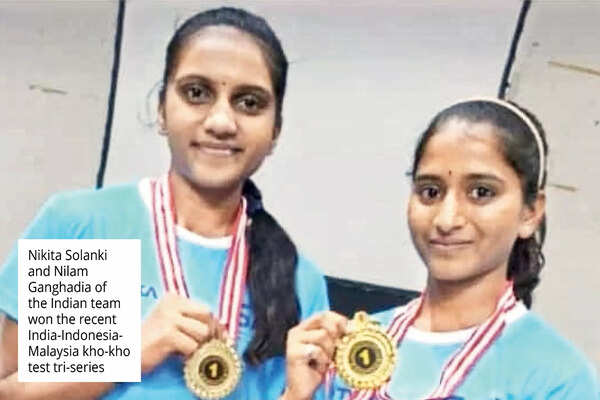
On Thursday evening, 30 of these kho-kho girls, in the age group of 7 to 20 years, gathered at the Hadala school ground for an announcement by their retired schoolteacher and coach Chandrasinh Jadav. Their seniors, Nilam Ganghadia, 20, and Nikita Solanki, 21, were being felicitated in Gandhinagar since they were part of the Indian team that won the India-Indonesia-Malaysia kho-kho test tri-series held in mid-October.
“These young girls have sweated it out on this rough terrain, overcoming injuries and personal setbacks. They have never given up and that is what winning is all about,” says Jadav, whose students have won three golds, 17 silvers and 15 bronze medals in national events since they began training in 2006. Today, in a team of 15 representing Gujarat, an average of five girls in the under-14, under-17 or under-19 categories are from Hadala village.
The Hadala story dates to 2005 when the team lost a taluka-level kho-kho match.
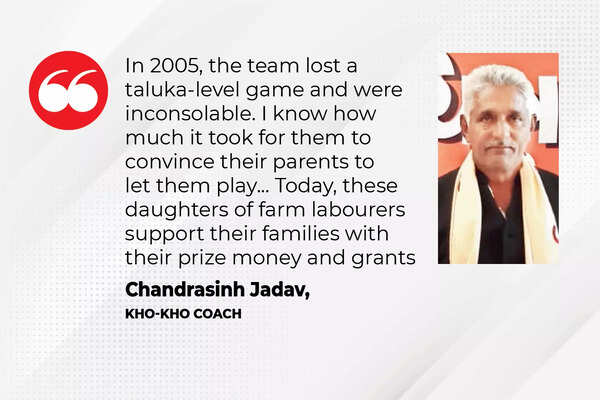
“That year our girls’ kho-kho team lost a taluka-level game and were inconsolable. I know how much it took for them to convince their parents to let them play kho-kho. Losing the game left them shattered. But the defeat was also good learning,” says Jadav, a national volleyball player. Kho-kho requires two poles, an open ground with a 9x25m space, speed, good teamwork, and nine minutes of determination. “It is a game that does not require costly equipment,” explains Jadav. The coach and school administrators ensured the ground was accessible only to the girls after 5.15pm.
“I needed the village’s support and their trust, and they gave it to me,” says Jadav. Rasna Makwana, 20, who has played 18 national matches in 12 years, aspires to be a coach, “Kho-kho gives me opportunities to see new places and meet new people. It builds my self-confidence,” she says. Her teammate Asha Makwana adds, “I like kho-kho because it teaches me to strive and excel. It also helps me support my family financially.”
Today, of the 30 girls who come to the ground, 15 get a Centre of Excellence monthly purse of Rs 4,500 for winning medals for the state. Three girls get Rs 10,000 a month under the Khelo India grant for national competitions.
“They have saved up to Rs 5 lakh for their wedding from the Rs 10,000 they get as grants. They are inspiring other girls to become independent and take control of their lives,” says Jadav.