By 2024, Uttar Pradesh’s temple town Ayodhya may witness the “biggest transformation in the history of the ancient city” as apart from the ongoing construction of the Ram Temple, over 200 developmental projects worth Rs 30,923 crore are in the offing.
In an interview with News18, Ayodhya’s district magistrate, Nitish Kumar, discussed a series of beautification projects, which he said would make Ayodhya “the most beautiful city in the world by 2024”.
“At present, more than 200 development projects worth Rs 30,923 crore are in progress in Ayodhya. We are working round-the-clock to ensure that all ongoing projects that aim to make Ayodhya the most beautiful city in the world get completed by 2024,” said Kumar.
Development of airport a challenging task
Kumar said the development of the Maryada Purshottam Shri Ram International Airport was the most crucial one. “The work of the airport is almost complete. Under the project, we acquired around 821 acres of land. Construction of the runway, the installation of CAT-1 and RESA facilities that facilitate night landings or landings in extreme weather conditions, are done. The construction of the ATC tower has also been completed,” he said.
Kumar added that the Airport Authority of India (AAI) will examine several factors, including instrument landing system (ILS), localizer glide path etc, before giving the final nod for flight operations. Barring some final touches and residual work in the terminal building, which is expected to get completed by the time of the consecration ceremony of Lord Ram’s idol on January 22, 2024, the rest of the work has been completed,” he said.
Initially, small aircraft with a seating capacity of 60 passengers will land at the airport, but by 2025, when the final phase of the airport is completed, it will be ready for Boeing airplanes, he added.
Ayodhya Junction
“Ayodhya junction’s rejuvenation, which is said to be one of the biggest facelifts that was carried out at a total cost of around Rs 620 crore, was another crucial project for Ayodhya’s development,” the district magistrate said.
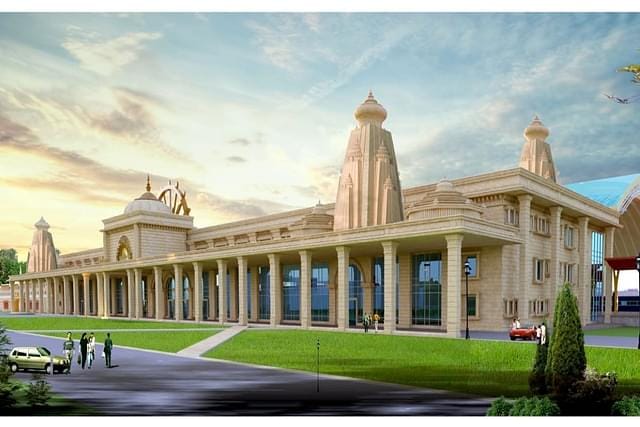
Under the project, which not only ensures the junction’s expansion but also its beautification and the introduction of passenger amenities, the external facade of the passenger terminal building was given a look similar to the Ram Temple.
The junction’s expansion work picked up pace in 2019. However, being a mammoth task, the entire project was divided into two phases.
The first phase included the construction of a new station building. “Under phase one, a three-storey building with a footprint of 140m x 32.6m has been constructed, spanning an area of 3,645 sqm, with an additional front porch of 140m x 12m to provide a drop-off zone and to protect the passengers from adverse weather conditions. Other than this, the other development work, including the construction of two six-meter-wide Foot Over Bridge (FoB), residential housing complex, facelift of platform number 1, 2 and 3 and beautification of the circulating area, construction of lounges, dormitories and ticket office were completed,” the DM said.
He said both the construction of the airport and the expansion of the railway junction were very important, as the inbound crowd of tourists and devotees is expected to multiply once the Ram Temple is opened to the public.
Paths and Corridors to ‘unclog’ Ayodhya
Crammed lanes and bylanes and traffic jams will no longer hinder the routes leading to the Ram Temple.

“Under the project, for which the UP government has allocated funds of around Rs 797 crore, the widening of roads leading to the Ram Temple has also been envisaged. Three paths have been shortlisted for the construction and expansion work. It includes the 2-km-long Ram Janmabhoomi Path that connects Sugriv Quila to Ram Mandir. Another is Bhakti Path, the 850-meter stretch that connects Shringar Hat to Ram Janmabhoomi. And the third one is Ram Path corridor, the 13-km-long stretch from Sahadatganj to Naya Ghat. “More than 1,000 workers have been pressed into service in order to complete all the three pathways by January 2024,” the DM said.
He said on the Ram Path, more than 800 establishments have been removed after acquiring the land in order to widen the stretch.
In addition, the UP government has also approved widening of the Panch Kosi, which passes through Ayodhya city and 14-Kosi Parikrama Marg which covers the outskirts of the city. Around 2,600 houses and commercial establishments will be demolished for the project.
Beautification of ancient ponds and religious places
Kumar said efforts are being made to beautify the entire city, including old Ashrams, ancient ponds and temples.
“We have shortlisted around 37 such religious places where the state tourism department is carrying out the rejuvenation work at a total cost of Rs 68.80 crore,” he said.
Janki Ghat, Bada Sthan, Dashrath Bhawan Mandir, Mangal Bhawan, Akshari Mandir, Ram Kachehri Mandir, Siyaram Kila, Digamber Akhara, Tulsi Chauraha Mandir, Bharat Kila Mandir, Hanuman Mandir, Kaleram Mandir, Nepali Mandir, Chitragupt Mandir and others are included in the renovation plan.

The Ayodhya administration has already completed renovation of Surya Kund, an ancient Sun temple situated around 5 km from the Ram Temple. “Bharat Kund will be developed on lines of Surya Kund. The significance and glory of the place will be restored and the water body will be revived,” the DM said.
Situated around 15 km from Ayodhya, Bharat Kund was the site where Lord Ram’s younger brother, Bharat, is said to have ruled his Kosala kingdom after Lord Rama was exiled for 14 years. At this place, Bharat also undertook penance as he waited the return of Lord Ram from exile, an administrative official said. The official said Bharat Kund is among the oldest water bodies in the state and hold significance for Hindus as it finds mention in the Ramayana.
Other than these prime projects, the DM said it would be ensured that most of the projects are completed by December 2023.
In the press conference, which UP Chief Minister Yogi Adityanath held in Ayodhya, he said the ongoing projects would be completed by December 31, 2023. While addressing the gathering on the occasion of Deepotsav, the eve of Diwali, Adityanath said Ayodhya is the favourite city of Lord Ram and the double-engine government is determined to develop it as the most beautiful city in the world.