

A satellite-tagged critically endangered adult White-rumped Vulture (Gyps bengalensis), one of the world’s most threatened species, has travelled approximately 600 km from the western lowlands of Nepal to the Pong area of Himachal Pradesh’s Kangra district, where it has recently been recorded occupying a nest.
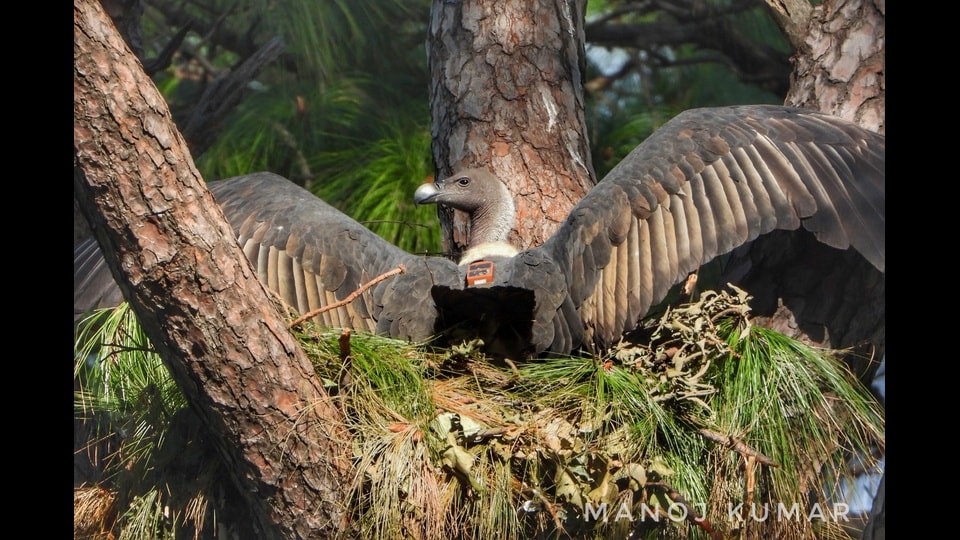
Malyasri Bhattacharya, a vulture biologist and member of the International Union for Conservation of Nature (IUCN) species survival commission (SSC) vulture specialist group, recorded the satellite-tagged bird sitting on a nest in the Pong area on November 4. The discovery provides valuable insights into the long-distance movement, habitat use, and breeding ecology of the species.
“This is very exciting news, as we have been able to locate a satellite-tagged bird that travelled approximately 600 km from Nepal to Himachal Pradesh, paired up, and is now occupying a nest,” said Bhattacharya.
The adult vulture was captured and fitted with a satellite transmitter in Shuklaphanta National Park, Nepal, on March 18, 2026. The tagging operation was jointly conducted by teams from the Department of National Parks and Wildlife Conservation (DNPWC), Bird Conservation Nepal (BCN), and the Royal Society for the Protection of Birds (RSPB).
Following its release, the tagged vulture remained in and around Shuklaphanta National Park for approximately two weeks before moving westward into Uttarakhand, India. The bird continued its journey further west and reached Himachal Pradesh in mid-April 2026.
“It reached Himachal Pradesh in mid-April. Since then, it has been moving within an area of approximately 45 km around the Pong region, which is a known nesting site of the species,” said Deelip Chand Thakuri, project officer at Bird Conservation Nepal, who has been closely monitoring the satellite-tagged bird.
The Kangra valley is an important vulture habitat, supporting a majority of the nine species recorded in India. The Chir Pine forests of Kangra serve as breeding habitats for the vultures, including the critically endangered White-rumped vultures in the region.
A study published by Bhattacharya in 2024 highlighted Kangra as home to the largest known populations of White-rumped Vultures in India. Further evidence comes from a Wildlife Institute of India study, which tracked five vultures using satellite transmitters. Three of these birds repeatedly nested in the same trees between 2021 and 2025, demonstrating the strong site fidelity of the species and the importance of mature Chir Pine forests.
However, these forests face growing threats from excessive resin tapping, forest fires and salvage timber extraction. Protecting these old-growth forest patches and their nesting trees is essential to securing the future of White-rumped Vultures in Himachal Pradesh.
“The arrival and successful nesting of J81 (the tag number for this bird) from Nepal once again demonstrates that conserving Kangra’s forests is not just a regional priority but an important contribution to vulture conservation across the Himalayas,” Bhattacharya said.
She added that satellite tracking has previously shown that White-rumped and Slender-billed Vultures (Gyps tenuirostris) tagged in Nepal frequently move across the Nepal–India transboundary Terai landscape. However, the long-distance movement of this individual to Himachal Pradesh and its subsequent association with a nesting site represent a particularly noteworthy observation.
Krishna Bhusal, Asia regional co-chair of the IUCN SSC vulture specialist group, said the finding highlights the importance of cross-border collaboration and a landscape-level conservation approach to safeguard these critically endangered species. “Joint monitoring of toxic veterinary drugs, eliminating their use, tracking vulture movements, and sharing information among conservation stakeholders and researchers in both countries are essential to ensure that Vulture Safe Zones remain genuinely safe for vultures,” he said.